
Changes ahead for tips and troncs
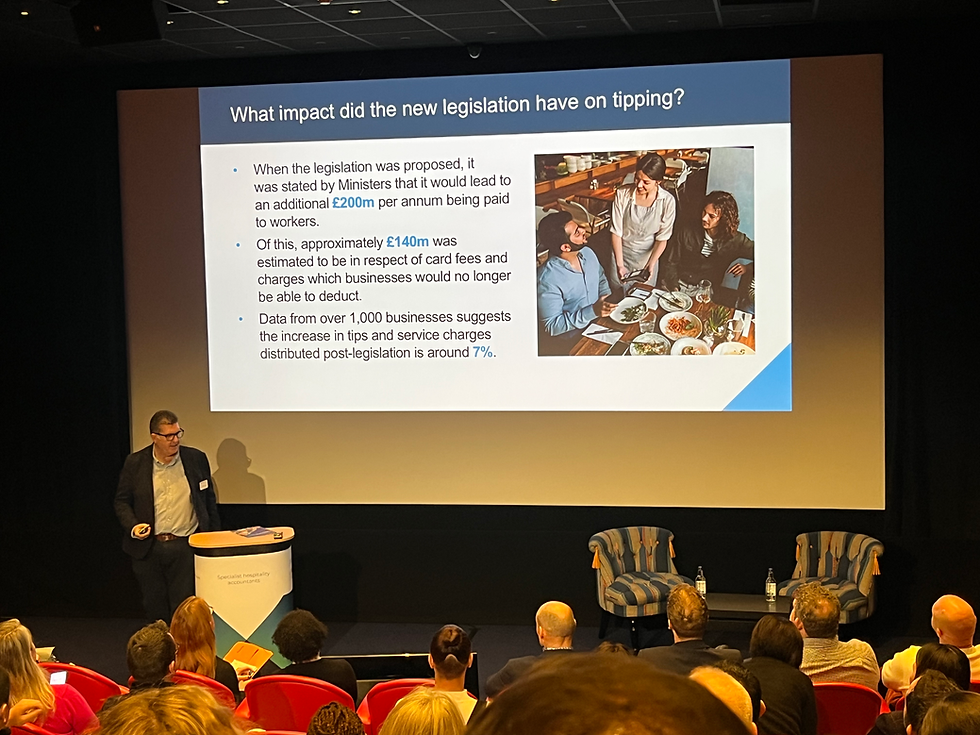
Peter Davies, partner, Moore Kingston Smith, said: “When this legislation was mooted, the government said it would bring in a significant amount of extra money because businesses were withholding it. In the impact assessments, the government believed it would lead to an additional £200m for staff.
"The businesses said that they were unable to swallow all the costs, of which around £140m is card fees and charges. Was this as big a problem as the government said it was?
“When the new legislation came in, the increase in tips was around 7%, so not the game changer that the government thought it was.
“The extra cost and regulations have prompted some small smaller businesses to stop accepting card payments for tips. As we know, cash is a dying breed. This has meant that, at the smaller end of the market, there are fewer tips. Some businesses are also considering that the arrangements aren’t fair to all their staff. What we are seeing is that some of the simple systems bought in after the legislation now need to be changed.
“Employment costs are also going up and this is conturing to drive an increase in service charges throughout the industry. They used to be rare, but are now more country-wide. Some operators have tried to bring in other charges - cover charges, linen charges - but some businesses have introduced them instead of, or in addition to service charges. We’re likely to see a tribunal case in this area next year.
“One if the problems with the legislation is that some of the parts are clear, but much of it relies on two words ‘fair’ and ‘transparent’ and those words are subjective. There is no legal way of defining them, they are opinions. The Code of Practice is vague on what ‘fair’ means and the tipping legislation places limits on ‘transparency’.
“Is ‘fairness’ based on a person-by-person basis, or on the team as a whole? It has to be the team as a whole. Is an equal distribution - ‘tip Communism as I call it’ - fair own those with greater skills or experience, or who have been there longer? The people who get a smaller share of the money will think it’s unfair and those who get more will think it is fair. Where is the burden of proof going to lie? It’s not clear.
“With ‘transparency’, the legislation doesn’t supersede the Data Protection Act, so we can’t talk about that. But in the mind of team members they now have a false expectation that they should know everything about what others receive.
"The first Employment Tribal case to test these issues in expected to be heard in late April 2026. It’s likely to be the first of many.
“The Employment Rights Bill changes the tipping legislation. There was a paragraph snaked in, something the new government always planned to do, which says that businesses have to launch a formal consolation with staff whenever a new tipping policy is introduce, or at least once every three years.
“We don’t know yet what form these consultations will take, but they are expected in early 2026. There will be further changes to the Code of Practice, but any further changes to the primary legislation are unlikely this year.
“Pre-election, the government said that it would give the unions full control. The government has accepted that this is not practical, but one of their intentions is that there will be greater trade union involvement.
“The next year is going to have as much change in it as the last year. We’re going to see changes to the tipping legislation, we’re going to see tribunal cases to clarify ‘fair’ and ‘transparent’.”


Comments