
The hotelier’s reality: from beating eggs to buzzing passion
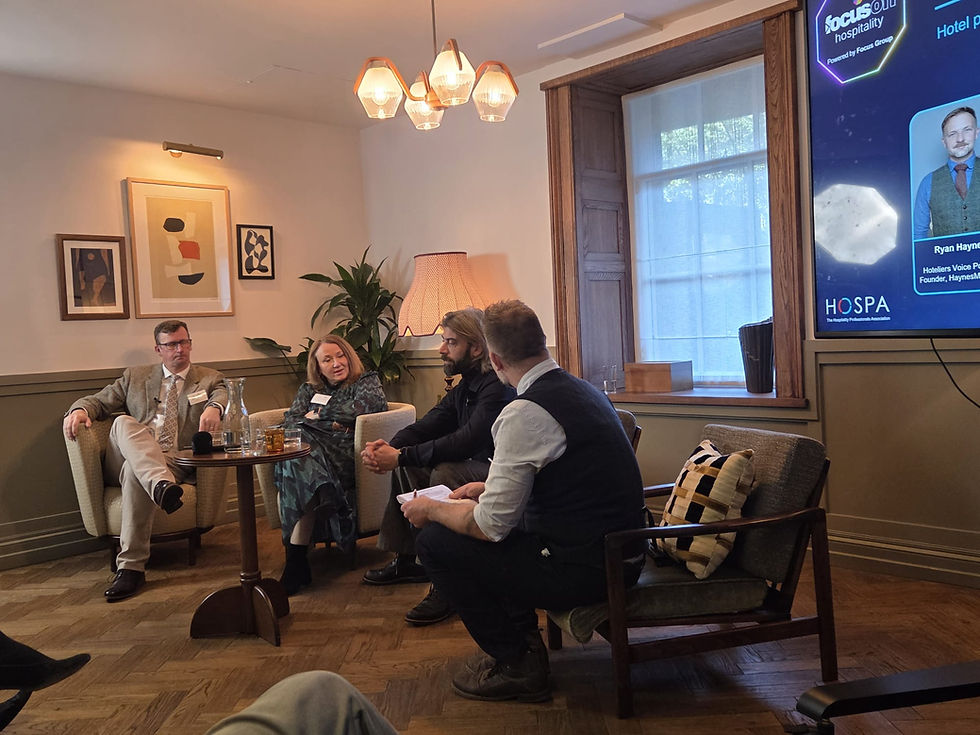
Ryan Haynes, director, lead consultant, Haynes MarComms, reports from the HOSPA Edinburgh event, Next Wave Hospitality: Tech Transformation sponsored by Focus on Hospitality.
Working in a hotel isn’t always polished. It can be messy, chaotic, and exhausting. But for every tricky situation, there are dozens more that make hospitality heroes feel on top of the world. Here, hoteliers tell me what reality looks like for them.
Behind systems, strategies, and shiny front desks, hospitality is powered by people. Always has been, always will be. It’s in the hectic, high-pressure moments that people shine brightest. Navigating the chaos, while still delivering a top-notch guest experience.
At the HOSPA Edinburgh event, Next Wave Hospitality: Tech Transformation sponsored by Focus on Hospitality, I heard stories that capture the reality of life in hospitality perfectly. From a hotel owner scrambling eggs for guests at a moment’s notice, to empowering staff to offer surprise gifts, these are the moments that make our industry so vibrant.
So how are hoteliers operating under the pressure, and still staying ahead?
Making guests feel seen
For all the change in hospitality, hoteliers say that one thing hasn’t shifted: guests want to feel seen, recognised, anticipated. So how do busy hoteliers navigate this?
For some, the human connection is established before guests even arrive. “We call every single guest seven days before arrival,” Barry Makin, General Manager of the Cromlix Hotel, shared. “Just to introduce ourselves, see if there’s anything we can do for them.” The hotel does the same for restaurant bookings (and they regularly have 2,500 per month).
This is a massive human undertaking. And not everyone answers the phone. But it’s about setting the right tone, however much time it takes.
For others, the approach to connecting with guests is shaped by accident. “Because I didn’t know anything about hotels, we actually ended up using WhatsApp as our very first communication tool,” said Mike Baxter, founder of House of Gods hotels. “I didn’t know what a PMS was!”
But what started as a workaround became a philosophy, crafted through connecting with guests in a way that felt familiar. “With House of Gods, we’ve created a story and a type of brand where the customer is seen,” Mike said. “Fundamentally, the customer is seen by the product delivering the experience that resonates with them deeply.”
It’s a simple idea, but an important one. After all, most guests aren’t arriving with complaints in mind. “Rarely is somebody coming to reception going, ‘I’m going to have a really crap time tonight,’” he said. “They’re coming with optimism and excitement.”
The modern day hotelier’s job is to meet them there, and elevate that feeling even further.
Carefully aided by tech
Hoteliers are deeply aware that technology is reshaping hospitality at speed. But on the ground, the approach is measured. There’s curiosity. Experimentation. And a healthy amount of scepticism.
“I don’t want to delegate everything over to AI,” Barry said. The Cromlix Hotel is experimenting with smart cameras that recognise car number plates from the car park, so staff can greet guests by name. But there are limits to this, and Barry has vetoed its use for restaurant bookings, as there are just too many. He said: “Just because you can do something doesn’t mean you should.”
That balance is key. Some guests want seamless, digital interactions. Many still want a conversation.
But AI is making an impact, behind the scenes at least. At Crieff Hydro Family of Hotels, a bot is handling 24 repetitive tasks in reservations, fixing booking data and clearing admin. “It’s those mundane, boring tasks…that someone used to have to do,” explained Lorraine Garvie, Head of Commercial Operations. “Initially it was about reducing staff… but actually we didn’t reduce the staff, we used them in a different way.”
At House of Gods, the approach is balanced too. Mike believes technology has been transformational for operations, such as rota software using AI. “It was only a couple of years ago that I was writing on the back of a bit of paper, trying to work out whether or not Steve had time to work on Thursday!” he said.
But tech isn’t always appropriate, and the House of Gods butler service could never be replaced by it. Mike said: “I can assure you, if that was delivered on one of these vacuum-keeper-style robots, the experience wouldn’t be there. That's the human interaction part.”
Nurturing a culture
If technology sets the stage, it’s culture that brings hospitality to life. In some of the most successful hotels, teams aren’t just following processes. They’re trusted to make decisions.
“Our team has full autonomy,” Barry said. “If somebody wants to give a guest a drink in the bar, or a little cake from the kitchen for their birthday, or drive them into town to go and see one of the artisanal shops, they can do that.”
Hospitality often happens in unpredictable conditions. So developing that trust matters. Underpinning this approach is a shared understanding of what hospitality actually is.
“Everything is experiential,” Barry said. “It’s more than the bed. More than the stay. It’s everything that surrounds it, and the only people that can really deliver that is the team you’ve got.”
Hoteliers have witnessed first-hand how empowering staff helps them step up to the demands of hotel life. Mike describes it as giving them “purpose” – critical to so many elements of hospitality.
Embodying great hospitality
The experienced hoteliers of today want the incoming generation to know they’ve all had a rollercoaster of a journey, and that’s part of what they love about it.
In the early days of launching his first property – a hostel with a boutique hotel aesthetic – a sleep-deprived Mike realised he had no breakfast for his guests. “So I ran across to Tesco, bought loads and loads of eggs, and YouTubed ‘Gordon Ramsay's best scrambled eggs,’” he laughed. “People came in and I’m handing them out, and the reaction I got was incredible. They were saying: ‘Don’t you own this place?’ I realised at that point, after a little bit of sleep, that great hospitality is welcoming somebody into your own home.”
The personal service, even in imperfect conditions, is meaningful to guests. Lorraine found this through her own journey in hospitality too. Drawn to the energy and connection of working in a nightclub, she switched from a business degree to a hospitality one, and started out in events at the Sheraton hotel in Edinburgh.
For Lorraine, the real satisfaction came from being fully immersed: tasting the food, feeling the atmosphere, and being present with clients from start to finish. “I just loved the buzz,” she said. That buzz extended to moments of chaos due to building work in Edinburgh city centre. “I remember having events when they were drilling the volcanic rock to build the One Spa, and having to run out to try and stop the builders so a person could do their keynote speech!”
Barry started out as a telecoms engineer for the army and police, before taking a bartending job to help support his young family. “I just fell into it,” he said. “And the great thing about it is all the clichés. It's different every day, but the biggest thing for me is you can actually see the impact you have on people's lives.”
The pull of hospitality
The thread running through all these hoteliers’ tales is connection. To guests, colleagues, a hotel brand they believe in, and with the hospitality sector as a whole.
There can be long hours, unpredictable days, and constant problem-solving. It’s not always easy, but it’s rarely dull.
The most important moments in hospitality aren’t scripted. They’re improvised. A perfectly timed gesture. A last-minute solution. A plate of scrambled eggs made under pressure! That’s what guests remember.
That’s the reality of being a hotelier. And it’s also what makes it totally worth it.


Comments