
Hospitality Sector Index
Moore Kingston Smith's June Hospitality update: growth through productivity – but at what cost?
Fine dining and hotels outperform as hospitality businesses generate more from fewer labour hours, raising important questions about workforce wellbeing, engagement and service sustainability.
June trading reinforced the increasingly polarised nature of the UK hospitality market. Premium and experience-led segments continued to outperform, while value-led dining and some pub and bar operators faced more challenging trading conditions.
Our data shows fine dining and hotels delivering the strongest performance, combining revenue growth with labour efficiency improvements. Casual dining remained under pressure as consumers continued to manage discretionary spending carefully, while pubs and bars experienced mixed performance, with trading outside London significantly outperforming the capital.
The results mirror broader industry trends. External market data shows hospitality sales across major pub, bar and restaurant operators remained broadly flat year-on-year during June, reflecting subdued consumer confidence and continued inflationary pressures. Pubs remained the strongest performing managed segment nationally, while restaurants and bars saw softer trading.
The industry’s productivity drive continues at pace. Hospitality businesses are generating more revenue from fewer labour hours as they respond to rising employment costs and economic uncertainty. While this demonstrates improved operational efficiency, it also creates a growing people challenge: teams are increasingly being asked to deliver the same service standards with fewer hours available. The sustainability of this approach will be a key test for the sector, particularly as Employment Rights Act reforms and Statutory Sick Pay changes add further pressure to workforce planning.
Looking ahead, the sector enters the peak summer trading period with cautious optimism. Consumer demand for premium experiences, domestic tourism and seasonal leisure activity should support performance, although cost inflation, recruitment challenges and fragile consumer confidence will remain important headwinds.
Restaurants, pubs and bars –June 2026

Sub-sector performance
Fine dining
Fine dining remained the standout performer in June, with revenue increasing 5.21% month on month while labour hours fell 0.25%. The result highlights the sector’s ability to drive growth while maintaining tight control of labour costs, further improving productivity.
Demand for premium dining experiences continues to prove resilient despite wider economic pressures. Consumers remain willing to spend on occasion-led visits and quality experiences, supporting revenue growth across the segment.
The annual picture is equally strong. Compared with June 2025, revenue increased 8.64% while labour hours declined 4.63%, demonstrating both robust demand and operational efficiency. Performance was particularly impressive in West London, where revenue grew 15.31% year on year, reflecting sustained strength in affluent markets and high-spending customer bases.
By combining strong sales growth with disciplined labour management, fine dining continues to outperform the wider hospitality sector and reinforce its position as the market’s strongest-performing segment.
Casual dining
Casual dining continues to face challenging trading conditions, as value-conscious consumers remain selective with discretionary spending and dining-out occasions.
Revenue declined 1.21% month on month in June, while labour hours fell 0.62%, reflecting softer demand following a stronger May that benefited from bank holiday trading and seasonal activity.
The annual picture remains challenging, with revenue down 9.91% and labour hours down 9.68% compared with June 2025. While operators have responded with disciplined cost control, demand remains subdued and recovery continues to lag behind other hospitality sub-sectors.
As a result, value, promotions and operational efficiency are likely to remain key priorities as the sector navigates a cautious consumer environment.
Pubs & bars
Pubs & bars had a challenging June, with revenue declining 3.22% month on month while labour hours increased 1.90%. However, performance varied significantly by region. While London venues experienced weaker trading, pubs and bars outside London delivered strong growth, with revenue increasing 8.77%, supported by seasonal tourism, exceptionally warm, dry and sunny weather and robust local demand.
Remember, some of the summer’s event led uplift is typically felt in July rather than June. Notably in 2026 operators are expecting to benefit from increased footfall associated with major sporting events, including the FIFA World Cup, much of that uplift is likely to materialise later in the tournament as audience engagement intensifies in July.
Despite June’s softer monthly result, the annual picture remains positive. Revenue increased 1.61% compared with June 2025, while labour hours rose 0.92%. This suggests underlying demand remains stable and that operators continue to invest cautiously in staffing to support trading activity.
The sub-sector’s ability to maintain annual growth despite short-term fluctuations reinforces its position as one of the more resilient areas of the hospitality market.
Hotels – May 2026*
*The hotel data reflects a period one month earlier than the restaurant data due to an industry reporting lag.
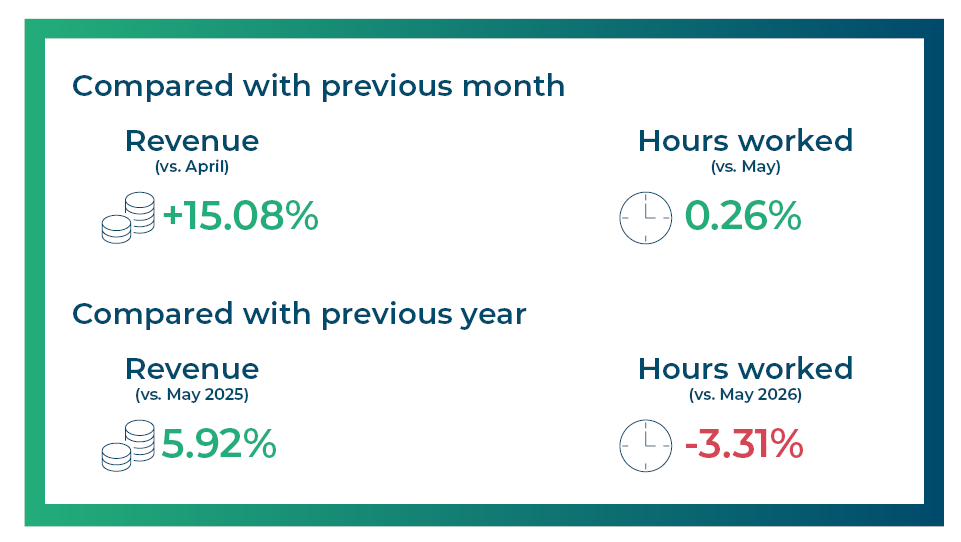
Hotels delivered the strongest monthly performance across the hospitality sector, with revenue increasing 15.08% month on month while labour hours rose just 0.26%. The result points to stronger demand and improving productivity, with operators growing sales while keeping staffing levels largely unchanged.
Performance was supported by the fine weather, the two May bank holiday weekends, alongside stronger business travel activity and the build-up to the summer tourism season.
The annual picture is also positive. Compared with May 2025, revenue increased 5.92% while labour hours declined 3.31%, highlighting continued efficiency gains and disciplined labour management.
Growth was particularly strong in West London, where revenue rose 8.51% year on year, reflecting healthy demand across both business and leisure travel markets. As the sector enters the peak summer period, hotels appear well positioned to maintain this momentum.
Employee wellbeing – the hidden cost of productivity gains
One of the clearest trends emerging from the June data is the continued reduction in labour hours across much of the hospitality sector. While this reflects strong cost control and improved productivity, it also raises important questions about workforce sustainability.
Across the portfolio, labour hours were down 5.92% year-on-year, significantly outpacing the 1.05% decline in revenue. In fine dining and hotels, revenue growth has been achieved while reducing labour hours, demonstrating impressive operational efficiency. However, these gains may be placing increasing pressure on frontline teams.
Potential risks include:
increased workload intensity for employees;
reduced time for training and development;
greater risk of burnout and fatigue;
challenges maintaining service standards during peak trading periods;
increased employee turnover and retention risks;
rising pressure on managers balancing service delivery with tighter labour budgets.
The sector is simultaneously navigating higher employment costs, ongoing recruitment challenges and forthcoming employment law changes. The introduction of Day 1 Statutory Sick Pay and wider Employment Rights Act reforms are expected to sharpen focus on workforce planning, attendance management and employee wellbeing.
Leadership consideration
The key question for hospitality operators is no longer simply “How do we reduce labour costs?” but “How do we maintain service excellence, employee engagement and business performance with fewer available labour hours?”
As the industry enters the peak summer trading period, successful operators are likely to be those that balance productivity improvements with investment in colleague wellbeing, manager capability and workforce resilience.
Key leadership takeaways
Premium positioning remains the strongest growth driver, with fine dining continuing to outperform the wider hospitality market through a combination of strong demand and operational efficiency.
Productivity is increasingly separating winners from the rest of the market. Hotels and fine dining are successfully delivering revenue growth while tightly controlling labour hours, demonstrating strong workforce optimisation.
The sector is entering a new phase of labour management. Rising wage costs, National Insurance increases and forthcoming Employment Rights Act changes mean labour deployment, workforce planning and scheduling discipline have become strategic business priorities.
Employee wellbeing is emerging as a critical business risk. Across much of the sector, teams are being asked to deliver similar or higher levels of service with fewer available labour hours. The sustainability of this approach will require careful monitoring.
Service quality, engagement and retention may become the next battleground. While productivity gains are protecting margins today, operators must ensure that increasing workload intensity does not negatively impact colleague experience, customer satisfaction or employee turnover.
Regional markets continue to outperform London in several hospitality categories, highlighting the importance of local market dynamics, tourism and consumer behaviour in driving performance.
Consumer spending remains selective, favouring premium experiences, occasions and perceived value, creating continued challenges for the casual dining sector.
Successful operators will balance performance and people. The businesses best positioned for long-term success are likely to be those that combine productivity improvements with investment in colleague wellbeing, manager capability and workforce resilience.
Hospitality has demonstrated it can generate more output from fewer labour hours. The key question for leaders is whether service standards, engagement and wellbeing can keep pace with these productivity gains over the long term.


Comments