
Storytelling delivers stronger marketing
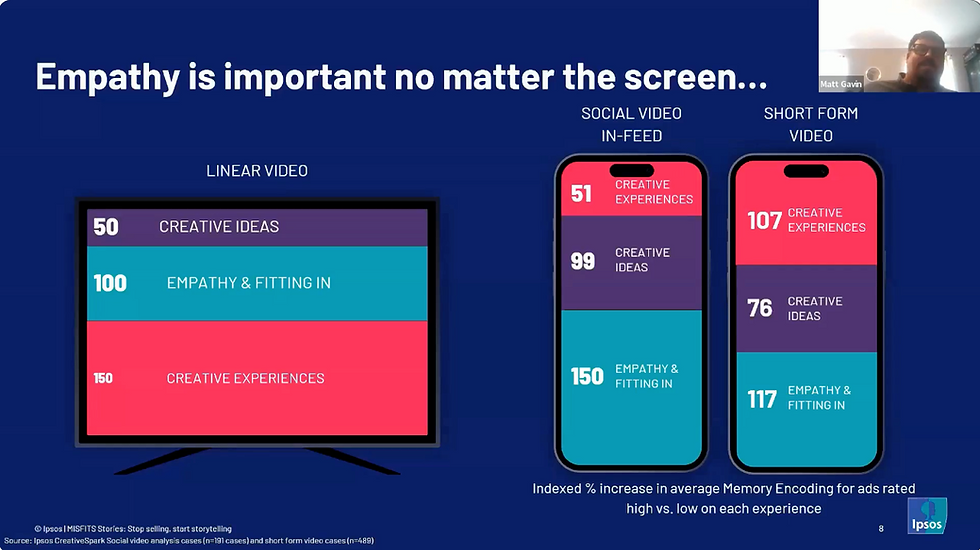
Hotel marketers should focus less on selling and more on storytelling if they want to improve advertising performance, according to Matthew Gavin, director of creative excellence at Ipsos, during a webinar hosted by HOSPA and the Hotel Marketing Association.
Gavin outlined research showing that creative storytelling could significantly improve advertising memorability, strengthen brand relationships and drive consumer behaviour, opening by highlighting what he described as a "creativity gap" in marketing.
"Did you know that when we interviewed marketeers, 67% agree that creativity within advertising provides extremely competitive advantage," he said. "And yet inherently there's a creativity gap that exists because only 12% of marketeers that we interview feel extremely confident to go to their CFO and actually make the case for investment in creativity in advertising."
Drawing on Ipsos' global database of more than 15,000 tested advertisements and interviews with over two million consumers, Gavin explained that the most effective advertising consistently succeeds across three key areas: delivering a strong creative experience, communicating a clear creative idea and creating empathy with audiences.
"The more you have a creative experience, the more likely people are to remember your ad," he said, while adding that empathy not only amplifies memorability but also "affects people's short-term behaviour. It affects the outcome you get from the ad."
According to Gavin, combining creativity with empathy could produce "a 20% increase in what we call creative effect," ultimately improving advertising's impact on sales and market share.
Throughout the webinar, he demonstrated how storytelling techniques could outperform purely functional advertising, using award-winning campaigns from brands including KitKat, M&M's and Ovo Energy.
Research presented during the session found that only around half of all advertisements told a relatable story, despite storytelling having played a central role in influencing human behaviour throughout history.
"Storytelling has been a very, very important way to change human behaviour over the course of human history," Gavin said.
He also highlighted the measurable impact of humour in advertising, noting that humorous campaigns typically generate a 14% uplift in memorability, while unexpected or illogical storytelling could be even more effective.
"The really important thing about this is it must fit your brand and the tone of your brand," he said.
While emotional advertising remained valuable, Gavin argued that emotion alone was not enough. Instead, marketers should communicate a clear value proposition within a narrative structure.
"If you wrap that value proposition in a narrative with a beginning, middle, and end, where characters go on a journey, you're twice as effective at influencing people's behaviours as if you just simply talk about the features in absolute terms," he explained.
During a question-and-answer session, attendees asked how storytelling should vary across digital platforms. Gavin said marketers should first understand why audiences use each platform and how quickly they engage with content.
"I think it fundamentally comes down to two things. Why are people on the channel in the first place?" he said. "The other thing that's very important is how they interact with the platform."
On channels such as Facebook, where users may only view an advertisement for a few seconds, Gavin stressed the importance of delivering a compelling opening.
"What I need is a killer visual to kick my ad off," he said.
Asked how organisations should measure the effectiveness of storytelling, Gavin encouraged marketers to test creative ideas with customers before investing heavily in production and to evaluate campaigns over the long term.
"I would say talk to consumers early in the process, back and forth with them, understand things about the narrative and what resonated with them, dial those things up," he said.
He also advised marketers to look beyond immediate sales metrics. "You have to kind of invest in it over time, and you have to look at the long-term success measures," he said.
Closing the session, Gavin summarised the principles behind effective storytelling.
"You want the brand's value proposition to be there, but you want it to be there, wrapped in a narrative with the beginning, middle, and end, because the combination of those things is what can elicit the real behaviour change," he said.


Comments