
The Next Battleground for Direct Bookings Isn't Traffic, It's Conversion
For years, hotels have invested heavily in attracting more guests through SEO, metasearch, paid advertising, loyalty programmes and direct booking campaigns. Those investments remain essential, but in today's competitive market, generating demand is only part of the equation.
The next competitive advantage lies in converting the demand hotels have already worked hard, and spent money, to acquire.
With operating costs continuing to rise, every abandoned booking represents lost revenue and wasted marketing investment. Understanding why guests abandon the booking journey is therefore no longer simply a marketing challenge, it is a commercial one.
As Jane Pendlebury, CEO of HOSPA, explains: "Attracting guests is only half the challenge. Every visitor who reaches a booking engine represents marketing investment that has already been made. If they abandon because the journey is confusing, slow or frustrating, that investment is lost along with the booking. Improving conversion is therefore about much more than increasing bookings. It is about making better use of existing marketing investment, reducing unnecessary acquisition costs and protecting profitability."
It's a timely observation. As acquisition costs continue to rise, making better use of existing website traffic is becoming one of the most effective ways for hotels to improve profitability.
To better understand where hotels are losing potential guests, Profitroom recently commissioned an independent survey of 2,000 UK consumers who had booked a hotel within the previous six months. The findings suggest that booking abandonment is rarely driven by price alone. More often, it is the booking experience itself that causes travellers to pause, reconsider or leave altogether.
The booking journey has fundamentally changed
Today's guests don't simply search for a hotel and make a reservation.
Before reaching a hotel's booking engine, they may have searched Google, compared prices on online travel agents (OTAs), read reviews, browsed social media, checked maps and, increasingly, used AI tools to help plan their trip. By the time they decide to book, they've already invested significant time researching their options.
Consumers also compare hotel websites with every other digital experience they use every day. Ordering from Amazon, booking an Uber or streaming personalised content on Netflix has reshaped expectations around speed, simplicity and convenience.
For hotels, this means the booking journey is no longer just a transactional process. It has become part of the overall guest experience.
The research found that:
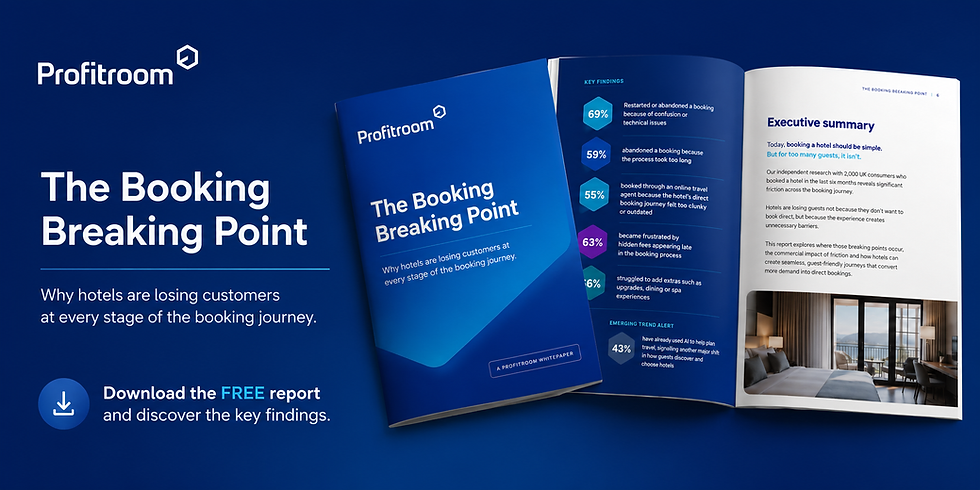
69% of travellers have restarted or abandoned a booking because of confusion or technical issues.
59% have abandoned a booking because the process took too long.
63% became frustrated when hidden fees appeared late in the booking journey.
55% booked through an OTA because the hotel's direct booking experience felt too clunky or outdated.
These findings suggest that many guests are not abandoning hotels. They're abandoning booking experiences that require too much effort.
Simplicity builds confidence
For many years, hotels have responded to increasing competition by offering more, more room types, more packages, more rate plans and more booking options.
But more choice doesn't always create more confidence.
As Maria Macree, UK Sales Director at Profitroom, explains: "For years, hotels have competed by adding more, more room types, more packages, more offers and more choice. But our research suggests travellers aren't looking for more options. They're looking for more confidence. Removing friction doesn't reduce choice, it helps guests choose."
Often, it's not one major issue that causes guests to leave. Instead, it's the cumulative effect of several small frustrations, unclear room descriptions, lengthy forms, confusing navigation or unexpected charges appearing late in the process.
Improving the booking experience doesn't necessarily require a complete redesign. Clearer pricing, simpler navigation, intuitive mobile experiences and fewer unnecessary booking steps can all help increase guest confidence and improve direct booking conversion.
Looking ahead
Consumer expectations will continue to evolve, particularly as AI becomes more influential in travel planning. Profitroom's research found that 43% of travellers have already used AI to help plan a trip, signalling another shift in how guests discover and choose accommodation.
For hoteliers, the message is clear.
Driving more traffic will always matter, but the hotels that outperform in the years ahead are likely to be those that make booking feel effortless. By removing friction and creating confidence throughout the booking journey, hotels can convert more of the demand they've already earned, reduce reliance on third-party channels and make every marketing pound work harder.
Read the full research
This article shares just a snapshot of the findings from Profitroom's Booking Breaking Point Report. The full report explores every stage of the guest booking journey, combining independent consumer research, industry perspectives and practical recommendations to help hotels reduce booking friction and increase direct bookings.
Access the free report: https://eu1.hubs.ly/H0xjT-y0


Comments